
Founders Award
Presented to an individual whose life's work embodies the truest, most uncompromising expression of what it means to Honor The Culture. Not the culture as a commercial product. Not the culture as a trend. The culture as a living, breathing, sacred art form — to be studied, protected, taught, and passed forward to the next generation with the same reverence it was received.

The Bronx: Where It All Begins
There are no accidents of geography in hip-hop. The Bronx did not merely produce Mickey Factz — it made him. Born Mark Anthony Williams Jr. on July 13, 1982, he grew up in the same borough where Kool Herc threw the block parties, where DJ Afrika Bambaataa planted the seeds of a global movement, where graffiti writers turned subway cars into rolling canvases, and where b-boys turned concrete into dance floors. He was born inside the origin story itself.
That context matters, because Mickey Factz has never treated hip-hop as a vehicle. He has always treated it as a responsibility. His father rapped to him as a child, imprinting the culture before he was old enough to name what he was receiving. He attended Adlai E. Stevenson High School — the same school that produced Afrika Bambaataa — absorbing both the academic rigor and the street-level musical lineage the institution carried. He then enrolled at New York University School of Law, only to walk away from a legal career to follow the pull of the art. That decision tells you everything you need to know about his priorities.
He chose the bars over the bar exam. And hip-hop has been better for it ever since.
Let's be precise about what Mickey Factz brings to the page. His craft is not the kind of lyricism that announces itself with a headline or a radio single. It is the kind that rewards careful listening — rhyme schemes that reveal themselves in layers, internal structures that only become fully visible on the third and fourth pass, wordplay that lands and then keeps landing. He has consistently referred to his music as poetry first, and the recordings bear that out. Every bar is measured. Every syllable is placed with intention.
The body of work that earned him the XXL Freshmen Class of 2009 cover — alongside future stars Wale, Kid Cudi, Curren$y, B.o.B, and J. Cole — was built the hardest possible way: one song at a time, released to the internet each week, with no label machinery, no radio push, and no viral shortcut. For 17 consecutive weeks during The Leak, Vol. 1: The Understanding, he dropped a record on MySpace and let the quality speak entirely for itself. The hip-hop community listened, and the hip-hop community responded. You cannot fake that kind of credibility. You can only earn it.
One of those weekly releases was "I'm Sean (50 Shots More)" — a song written entirely from the perspective of Sean Bell, the young man killed by New York police on the eve of his wedding in 2006. Factz stepped inside the victim's consciousness at a funeral and a press conference, using hip-hop to deliver social commentary with the precision of journalism and the weight of elegy. That is what a fully realized lyricist does with the form. That is what separates a rapper from an MC.
Mickey's first major project saw him rapping entirely over N*E*R*D instrumentals — not as a gimmick, but as a creative exercise in finding his voice within unconventional sonic territory. The project caught the attention of Pharrell Williams himself, signaling that the Bronx lyricist was operating at a level that industry tastemakers couldn't ignore. The culture took note.
A tribute to the music that shaped him, Flashback Vol. 1 saw Mickey record nearly 40 tracks and then remix over half of them — an almost obsessive creative commitment. The project demonstrated not just prolificacy but a disciplined pursuit of perfection. He wasn't making music to release. He was making music to get it right.
The Leak, Vol. 1: The Understanding pioneered an independent weekly release strategy on MySpace before it was an industry playbook. Vol. 2, The Inspiration, continued the model and featured a then-emerging Drake, Travie McCoy, and Tanya Morgan. The video for "Rockin' N Rollin'" featuring The Cool Kids earned MTV rotation. He was building the future of independent hip-hop distribution in real time.
Named to XXL's Freshmen Class of 2009 — one of the most consequential freshman classes in the magazine's history, featuring Wale, Kid Cudi, Curren$y, B.o.B, J. Cole, Charles Hamilton, Asher Roth, Blu, and Diggy Simmons. He was simultaneously named a Honda Accord brand ambassador, a mainstream crossover that only came because of his undeniable creative credibility.
Signed to Battery Records (Jive/Sony). Contributed "Rocker" to the Fight Night Round 4 video game soundtrack. Then, in a public radio announcement, Lupe Fiasco declared Mickey Factz a member of the All City Chess Club — the lyrical collective that also included J. Cole, Wale, B.o.B, Asher Roth, Pharrell, and Blu. A peer endorsement that carried the full weight of the culture's respect.
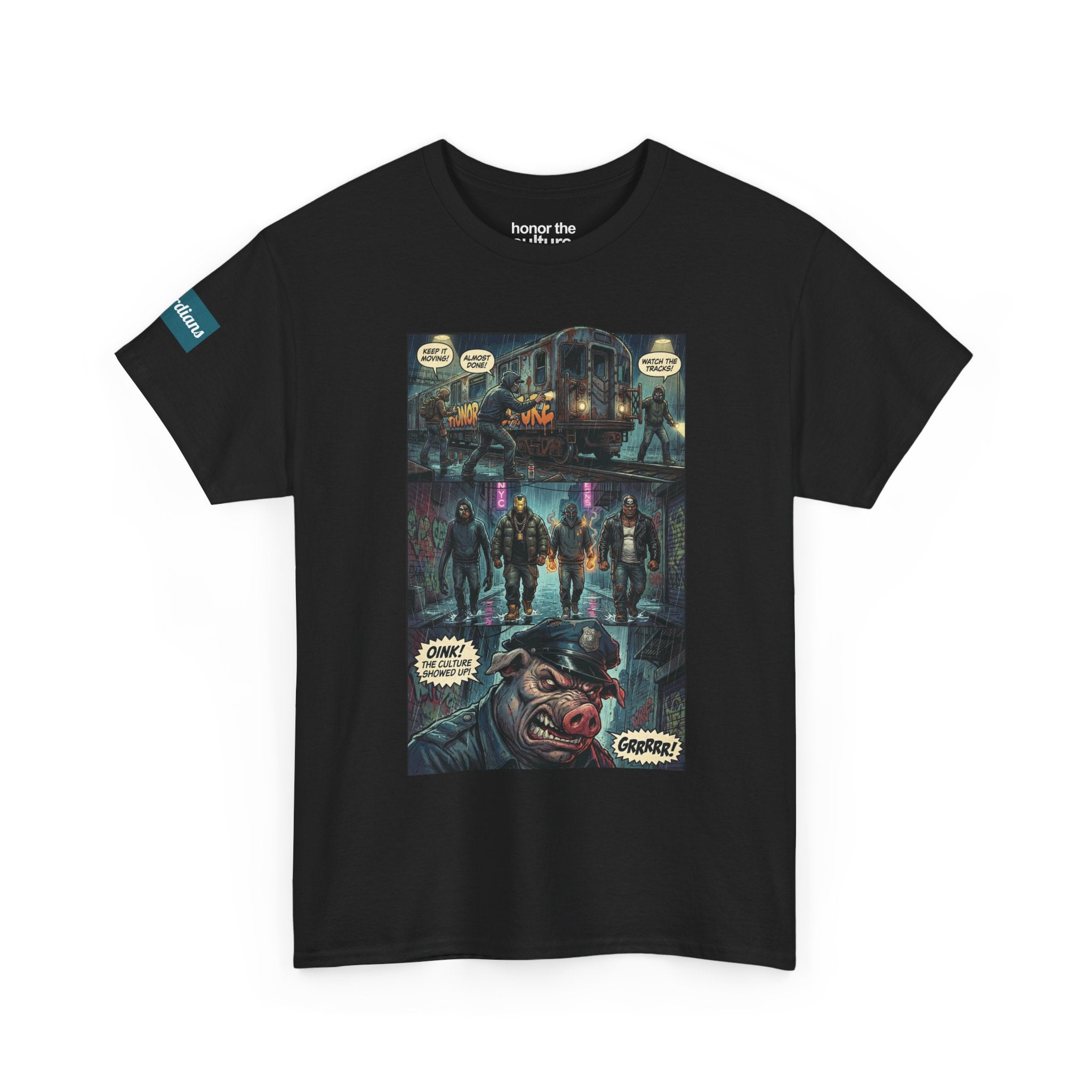
When his label deemed the Mickey MauSe project "too experimental" and refused to back it, Factz released it independently rather than compromise the vision. The concept — a pseudo-character transported to the 1980s as a Bronx graffiti writer — was a fully realized artistic statement rooted in deep research into that era's culture. Lupe Fiasco called it album-worthy and pushed for an executive producer credit. It stands as one of his most lyrically celebrated bodies of work.
After a decade of recording, touring with Big Sean and Lupe Fiasco, and running his own marketing firm GFC New York — whose clients included the late Nipsey Hussle — Mickey Factz turned his full creative energy toward education. When MasterClass declined his pitch, he built his own. Pendulum Ink, the first hip-hop academy of its kind, launched with Method Man teaching a class called "Rhymecology." His vision: physical schools in the Bronx, Atlanta, and Los Angeles by 2027.
What makes Mickey Factz the right recipient for the Honor Society Founders Award is not any single accomplishment. It is the consistency of his commitment across four distinct pillars that together define what it truly means to honor the culture.
The Pen
From his earliest freestyles to his most recent studio releases, the lyricism has never wavered. Intricate rhyme architecture, thematic depth, and a poet's precision in every verse. He treats language not as decoration but as the entire structure of the thing. This is what the culture was built on. This is what he has never abandoned.
Battle & Competition
Mickey Factz has a long history in competitive battle rap going back to the original leagues — Sacred Society — through hosting events at the Ultimate Rap League and competing at KOTD's Massacre event. He entered the Lupe Fiasco vs. Royce da 5'9" public exchange with "Wraith" and reminded everyone he is nothing to play with on a competitive stage. Real MCs compete. Real MCs show up.
Education & Legacy
Pendulum Ink and the Society of Spoken Art, which he co-founded, represent a commitment to the culture that goes beyond recording. He is building infrastructure for the next generation — teaching lyricism, building community, and ensuring that the art form is passed forward not as a commercial product but as a sacred tradition. Method Man teaches there. Legends teach there. The curriculum is real.
Community & Consciousness
From voicing Sean Bell's story at the height of a police brutality crisis, to running a marketing firm that served Nipsey Hussle, to building schools in communities that need them — Mickey Factz has consistently pointed his platform outward. The culture is not just music to him. It is a vehicle for truth, accountability, and community elevation. That is the original promise of hip-hop, and he has kept it.
From 2006's In Search of N*E*R*D through 2026's Manifest Destiny 2 — nearly two decades of documented creative output, built independently and on his own terms.
Alongside Wale, Kid Cudi, Curren$y, B.o.B, J. Cole, Asher Roth, Charles Hamilton, Blu, and Diggy Simmons. The class that defined a generation of hip-hop's direction.
Then Atlanta. Then Los Angeles. The goal: three physical institutions teaching hip-hop and lyricism as serious academic disciplines — starting in the borough that created the culture.
The Honor Society Founders Award was not created for the most commercially successful artist. It was not created for the most streamed, the most followed, or the most decorated by industry metrics. It was created for the artist who demonstrates, across an entire career, that the culture is the mission — not the means to something else.
Mickey Factz walked away from NYU Law School for hip-hop. He released music independently when labels said no. He chose artistic integrity over commercial compromise on Mickey MauSe when a lesser artist would have shelved the project or softened it. He built a marketing firm that served Nipsey Hussle. He got turned down by MasterClass and built his own institution. He is currently planning physical schools in three American cities — starting with the Bronx, where hip-hop was born, where he was born, where it all begins.
Every decision has pointed in the same direction: toward the culture, toward the community, toward the next generation of artists who need someone to show them that craft and conscience can coexist, that technical excellence and community responsibility are not competing values but the same value expressed two different ways.
If I didn't do this, somebody else not of the culture would've done it. — Mickey Factz, on why he built Pendulum Ink.
That quote is the Honor Society Founders Award in a single sentence. He saw a gap, he recognized the stakes, and he filled it himself — because he understood that the culture belongs to the people who built it, and it is their responsibility to protect it, teach it, and pass it forward intact.
From the Bronx, with a pen sharp enough to cut through everything the industry tried to put in his way — Mickey Factz has spent his entire career doing exactly what the award is named for. He has honored the culture. In every room. On every record. In every classroom. Without exception.




Leave a comment
This site is protected by hCaptcha and the hCaptcha Privacy Policy and Terms of Service apply.