

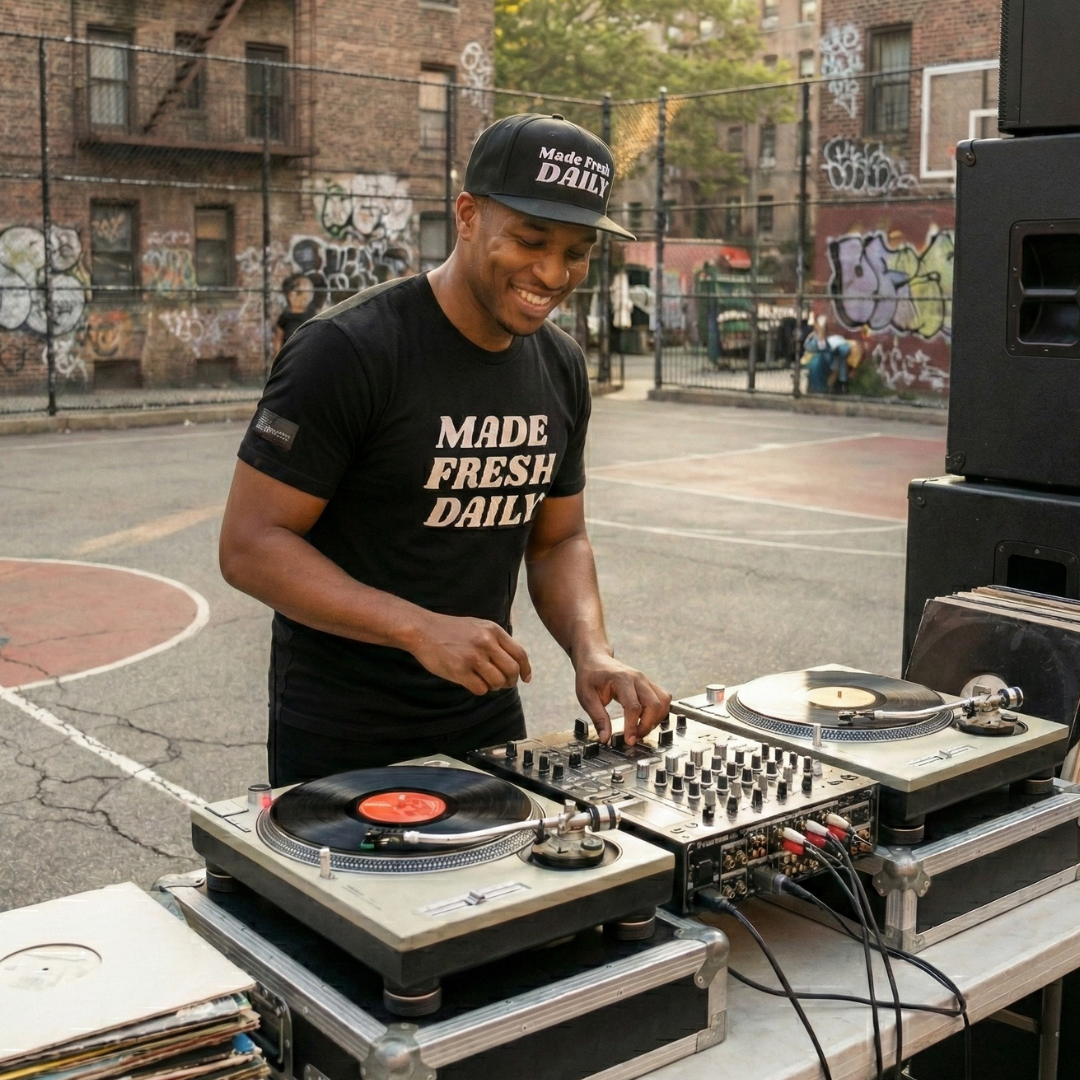
Herc didn't just play records. He observed the crowd. He noticed that the dancers, the energy, reached a fever pitch during the "breaks"—the instrumental, percussion-heavy sections of funk and soul tracks. So, he developed the "Merry-Go-Round" technique, using two turntables to isolate and extend those breaks indefinitely.
In that moment, the heartbeat of hip hop was started.
But what began as a local party trick in a borough neglected by city infrastructure and ravaged by poverty didn't just stay in the Bronx. It mutated, grew, traveled, and transformed into the most dominant cultural force on the planet. Today, hip hop is more than a genre, it is a universal language, a lens through which global culture is viewed.
To understand hip hop's evolution, you have to understand that it was never just about rap music. In the decaying landscape of the 1970s Bronx, amid fires and white flight, underprivileged youth created something from nothing. They built a culture defined by four distinct, yet interlocking, elements—with the tie that binds them (in the metaphysical sense).
DJing
The manipulation of sounds, the breakbeat, the scratch. The foundation laid by Herc, Grandmaster Flash, and Afrika Bambaataa.
MCing
The "Master of Ceremonies." Originally there to hype the DJ and keep the party moving, the MC eventually became the lyrical focal point, evolving into complex poetry.
B-Boying / B-Girling
The kinetic expression of the music. An athletic, competitive dance form that turned cardboard boxes on concrete into performance stages.
Graffiti
The visual language of the streets. Tagging and elaborate murals became a way for marginalized youth to say, "I am here. I exist."
Knowledge of Self
This vital fifth element provides the spiritual and historical context necessary to sustain and bind the four elements, facilitating the elevation out of mental slavery.
This was a complete ecosystem of expression, a way to dress, walk, talk, create, and BE. Don't take that last one as a slick add-on; the "Knowledge" element was actively codified and spread by foundational groups that saw hip hop as a tool for social and spiritual liberation.
The Empowerment Entities
Providing Identity to the MarginalizedThe Universal Zulu Nation: Founded by Afrika Bambaataa, the Zulu Nation transformed street gang energy into a global community centered on "Peace, Love, Unity, and Having Fun". They were the first to formally define the elements of the culture, ensuring that "Knowledge" was the glue holding the music and dance together.
The Five-Percent Nation: The Nation of Gods and Earths had a profound impact on the lyrical content and "slang" of the Golden Era. Their teachings on "Knowledge of Self" and the "Supreme Mathematics" influenced the rhymes of icons like Rakim, Wu-Tang Clan, and Brand Nubian.
The cultural empowerment of these groups provided a sense of identity and history, proving that hip hop was not just entertainment, but a "Black CNN" that provided an education the school system often failed to deliver.
If the 70s were the infancy, the mid-1980s to mid-1990s was hip hop's adolescence and young adulthood, a period widely known as the "Golden Era."
This period is revered not just out of nostalgia, but because of the staggering volume of innovation that occurred within it. The genre broke free from the disco-influenced party rhymes and entered a phase of intense lyrical complexity, diverse subject matter, and production wizardry.
Run-D.M.C. stripped away the funk costumes and wore street clothes, Adidas, Lee jeans, Kangol hats—bringing the look of the culture to MTV. Public Enemy, led by the booming voice of Chuck D and the chaotic energy of Flavor Flav, turned hip hop into the Black CNN, delivering searing political commentary over the Bomb Squad’s wall-of-noise production.
Simultaneously, the Native Tongues collective—groups like A Tribe Called Quest, De La Soul, and Jungle Brothers—introduced jazz samples, afrocentricity, and a bohemian vibe. On the West Coast, N.W.A. shattered norms with "Reality Rap," providing an unfiltered, harrowing look at police brutality and life in Compton. The Golden Era cemented the understanding that hip hop had no boundaries.
As hip hop moved into the late 90s and 2000s, it became too big to be contained by one sound. The regional walls broke down, leading to a massive diversification of subgenres. The focus shifted South to Atlanta, Houston, New Orleans, and Miami, birthing Trap music and the chopped and screwed sounds of Texas.
Globally, the seed planted in the Bronx found fertile ground everywhere. In London, it hybridized with Jamaican soundsystem culture to create Grime and UK Drill. In Latin America, it blended with reggae/dancehall to birth Reggaeton. The genre proved infinitely malleable, capable of absorbing local cultures while retaining its core DNA of rhythmic speech over beats.
It is impossible to overstate hip hop’s impact on wider society. It is the primary engine of youth culture globally.
Streetwear is fashion now. The sneaker culture born on basketball courts and hip hop stages now dictates the direction of luxury brands like Balenciaga and Louis Vuitton.
Hip hop slang permeates everyday speech. Words like "diss," "woke," "dope," and "bling" (added to the Oxford English Dictionary) all originated in the culture.
Hip hop created a blueprint for ownership. Figures like Jay-Z, Dr. Dre, and Rihanna didn't just make records; they built empires in headphones, spirits, fashion, and tech.
AND THEN! We find ourselves home again in the renaissance and the return of the golden era.
We are currently living through an interesting paradox. While trap beats and melodic autotune dominate the Billboard charts, there is a simultaneous, massive hunger for the "real thing"—the foundational boom-bap sound, lyricism, and storytelling of the Golden Era.
Nostalgia is a powerful drug, but this current resurgence is about more than just looking back, it's about preservation and honoring the architects while they are still here to receive their flowers.
And who better than Nas to bridge a gap we have all been hoping for. Leading the charge is Mass Appeal.
Originally a graffiti magazine in the 90s, Mass Appeal was resurrected as a media powerhouse with rap legend Nas as a core partner. The label and media company has become the premier curator of golden era hip hop culture, bridging the gap between the old school and the new.
Mass Appeal hasn't just signed legacy acts, they have committed to telling the story of the culture through high quality documentaries like the Peabody-winning Hip-Hop Evolution on Netflix, the definitive Wu-Tang Clan: Of Mics and Men, and numerous projects surrounding Hip Hop 50.
They understand that hip hop is now history, deserving of the same rigorous documentation as jazz or rock and roll. By releasing new music from lyrical heavyweights and meticulously cataloging the past, entities like Mass Appeal are ensuring the "Golden Era" isn't just a memory, but a living, breathing standard of excellence that continues to inspire.


Leave a comment
This site is protected by hCaptcha and the hCaptcha Privacy Policy and Terms of Service apply.